

What Are Economic Protest Parties
10.vi Minor Parties
Learning Objectives
After reading this section, you lot should be able to reply the following questions:
- What is a small-scale political party, likewise known as a third party?
- What are the types of pocket-sized parties in American politics?
- What difficulties do pocket-sized parties face up in winning elections?
A minor political party, or third political party, is an organization that is not affiliated with the 2 major American parties—the Democrats or Republicans. Pocket-size parties run candidates in a limited number of elections and they practise not receive big pluralities of votes. They ascend when the 2 major parties fail to correspond citizens' demands or provide the opportunity to express opposition to existing policies. Citizens oft form a pocket-sized party by uniting behind a leader who represents their interests.
Functions of Minor Parties
Minor parties raise issues that the Democrats and Republicans ignore considering of their tendency to take middle-of-the route positions. As a result, modest parties tin can be catalysts for modify (Mazmanian, 1974). The Progressive Party backed the women'southward suffrage movement in the early twentieth century, which led to the passage of the Nineteenth Amendment. Kid labor laws, the direct ballot of US senators, federal farm aid, and unemployment insurance are policies enacted as a outcome of third-party initiatives (Sifry, 2003).
More than recently, the Tea Party has raised problems related to the national debate, government bailouts to failing industries, and the health care organisation overhaul. The Tea Party is a conservative-leaning grassroots political movement that emerged in 2009 when the Young Americans for Freedom in the state of New York organized a protestation against country government "taxation and spend" policies. The Tea Political party–themed protest recalled events in 1773, when colonists dumped tea into Boston Harbor to demonstrate their opposition to paying a mandatory taxation on tea to the British regime. Subsequent Tea Political party protests took identify in states across the land. Tea Party supporters participated in national protests in Washington, DC, which drew thousands of supporters.
Video Clip
CNBC'due south Rick Santelli's Chicago Tea Party
(click to see video)
The national protests were prompted by a video of a rant past CNBC editor Rick Santelli opposing government subsidies of mortgages that went viral after existence posted on the Drudge Report.
Santelli called for a "Chicago Tea Party" protest, which ignited the motion. The Tea Party's efforts were publicized through new media, including websites such every bit Tea Political party Patriots, Facebook pages, blogs, and Twitter feeds.
Modest parties tin can invigorate voter interest by promoting a unique or flamboyant candidate and by focusing attention on a contentious issue (Mazmanian, 1974). Voter turnout increased in the 1992 presidential contest for the first time in over two decades in part because of minor-party candidate Ross Perot (Owen & Dennis, 1996). Perot, a wealthy businessman, was a candidate for president in 1992 for the small-scale political party, United We Stand America, receiving most twenty million votes. He ran once more in 1996 as a member of the Reform Party and earned well-nigh eight million votes (Green & Binning, 1997). Perot supporters were united in their distrust of professional politicians and opposition to government funding of social welfare programs.
Effigy 10.7 Ross Perot and Ralph Nader Campaigning
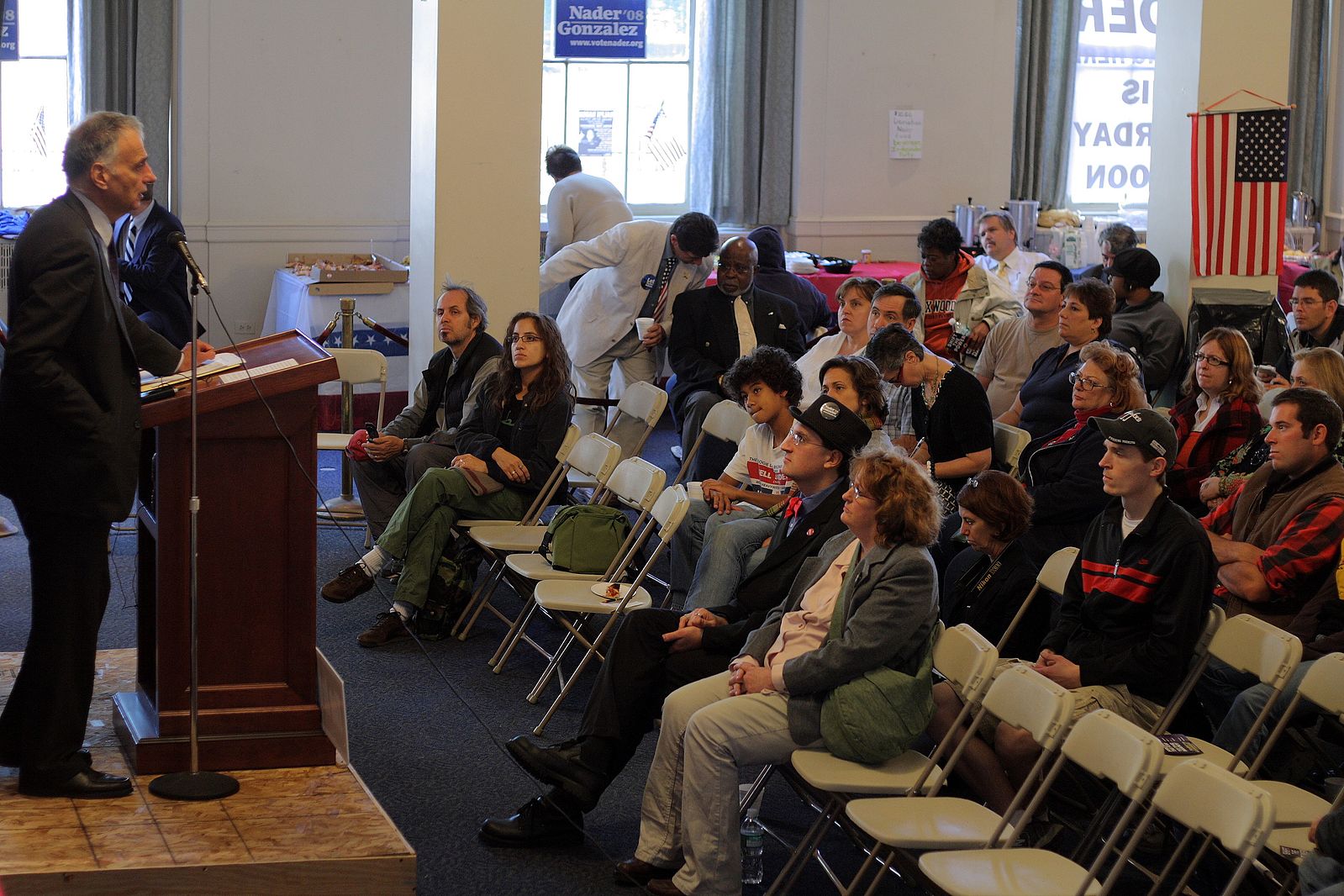
Minor-political party candidates Ross Perot and Ralph Nader did not come close to winning the presidency, simply they did bring media attention to issues during the elections in which they ran.
Small-scale party candidates can exist spoilers in elections by taking away enough votes from a major party candidate to influence the outcome without winning. Minor parties collectively have captured over five per centum of the popular vote in every presidential ballot since 1840, although individual minor parties may win just a small percentage of votes (Rosenstone, Behr, & Lazarus, 2000). Dark-green Party candidate Ralph Nader was considered by some analysts to be a spoiler in the 2000 presidential entrada by taking votes away from Democratic contender Al Gore in Florida. George West. Bush received ii,912,790 votes in Florida compared to Al Gore'southward 2,912,253 votes (Committee for the Study of the American Electorate, 2011). If 540 of Nader'south 96,837 votes had gone to Gore, Gore might have ended up in the White House (Sifry, 2003).
Types of Minor Parties
Minor parties can exist classified equally indelible, single-issue, candidate-centered, and fusion parties.
Enduring Pocket-sized Parties
Some minor parties have existed for a long time and resemble major parties in that they run candidates for local, land, and national offices. They differ from major parties because they are less successful in getting their candidates elected (Rosenstone, Behr, & Lazarus, 2000).
The Libertarian Party, founded in 1971, is an enduring minor political party, which is a type of minor political party that has existed for a long time and regularly fields candidates for president and state legislatures. The Libertarians are unable to compete with the two major parties because they lack a strong organizational foundation and the financial resource to run effective campaigns. The political party also holds an extreme ideological position, which can amerce voters. Libertarians take personal freedoms to the extreme and oppose authorities intervention in the lives of individuals, support the right to own and conduct arms without restriction, and endorse a complimentary and competitive economic market (Fell, 1997).
Single-Issue Minor Parties
Sometimes called ideological parties, unmarried-issue small parties be to promote a particular policy agenda. The Dark-green Party is a product of the environmental movement of the 1980s. It advocates ecology issues, such as mandatory recycling and strong regulations on toxic waste product (January, 1997).
Candidate-Centered Minor Parties
Candidate-centered minor parties form around candidates who are able to rally support based on their own charisma or message. Former World Wrestling Federation star Jesse "The Body" Ventura was elected governor of Minnesota in 1998 under the Independence Political party label, an offshoot of the Reform Political party. The plainspoken, media savvy Ventura made the need for an culling to 2-political party domination a core theme of his campaign: "It's high time for a tertiary political party. Permit's look at Washington. I'm embarrassed. We've got a lot of problems that the government should be dealing with, merely instead, for the next nine months, the focus of this nation will be on despicable beliefs by career politicians. If this isn't the correct time for a third political party, then when?" (Sifry, 2003)
Fusion Minor Parties
Fusion minor parties, likewise known every bit alliance parties, are enduring or single-outcome pocket-sized parties that engage in the do of cross endorsement, bankroll candidates who appear on a ballot under more than 1 party characterization. Fusion parties routinely endorse candidates who have been nominated by the two major parties and support their causes. Cross endorsement allows minor parties to contribute to the election of a major-party candidate and thus gain access to officeholders. In improver to giving a major-party candidate an additional ballot position, fusion parties provide funding and volunteers.
Merely eight states permit the practice of cross endorsement. The near active fusion parties are in New York. The Liberal Party and the Democratic Party cantankerous endorsed Mario Cuomo in the 1990 New York governor'south race, leading him to defeat his Republican Party and Conservative Party opponents handily. The Conservative Political party and the Republican Party cantankerous endorsed George Pataki in the 2000 governor'south race, leading him to victory (Gillespie, 1993). During the 2010 midterm elections, the Tea Party cross endorsed several successful candidates running in the principal nether the Republican Party label, upsetting mainstream Republican candidates. Some of the Tea Party–endorsed candidates, such every bit U.s.a. Senate candidate Rand Paul in Kentucky, went on to win the general election.
Comparing Content
The Tea Political party
There has been almost every bit much discussion about media coverage of the Tea Political party as in that location has been about the organization's issue positions, candidate endorsements, and protest activities. Tea Party activists, such every bit quondam Alaska governor and Republican vice presidential candidate Sarah Palin, take lambasted the traditional news media for being tied to special interests and irrelevant for boilerplate Americans. Instead, Tea Party leaders have embraced social media, preferring to communicate with their supporters through Facebook and Twitter.
Early Tea Party protests against government economic policies received picayune mainstream printing attention. Media coverage increased equally the Tea Party staged rowdy protests against government health intendance reform, and public involvement in the movement grew. Stories by major news organizations focused on the evolution of the Tea Party, its positions on issues, its membership, and its most vocal spokespersons. Tea Political party rallies garnered all-encompassing attending from mainstream media as well every bit political bloggers. The Tea Party received the lion's share of media coverage on ballot dark in 2010, as the mainstream press framed the election results in terms of public dissatisfaction with the political status quo as evidenced by victories by Tea Political party–backed candidates (Stelter, 2010).
Coverage of the Tea Party differs widely by media outlet. CNN reports of a Tea Party protest in Chicago featured on-site reporters aggressively interviewing average citizens who were participating in the event, challenging them to defend the Tea Party's positions on bug. CNN and network news outlets reported that members of Congress had accused Tea Political party protestors of anti-Obama racism based on racially charged statements and signs held by some protestors. Play tricks News, on the other hand, assumed the role of Tea Party cheerleader. Fob analyst Tobin Smith took the stage at a Tea Political party rally in Washington, DC, and encouraged the protestors. Reporting live from a Boston Tea Party protest, Fob Business ballast Cody Willard encouraged people to bring together the movement, stating, "Guys, when are we going to wake up and start fighting the fascism that seems to be permeating this country?" (Rogers, 2011)
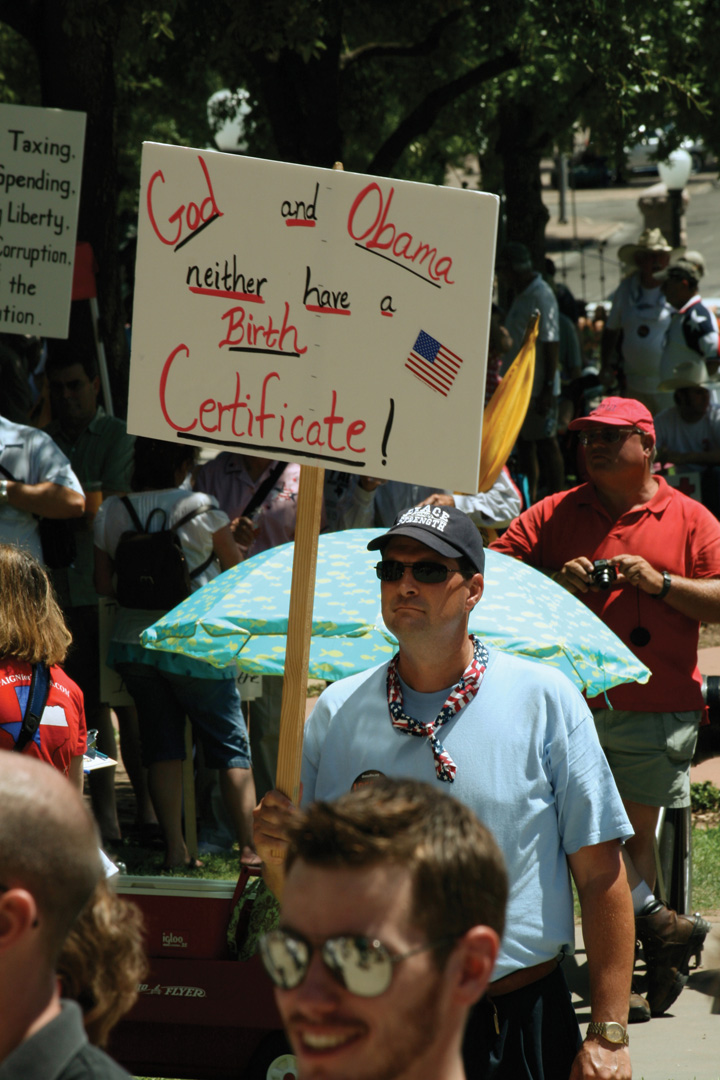
Tea Party signs at a rally. Media coverage of Tea Party rallies focused on racially charged signs prompting the movement's leaders to decry the mainstream press.
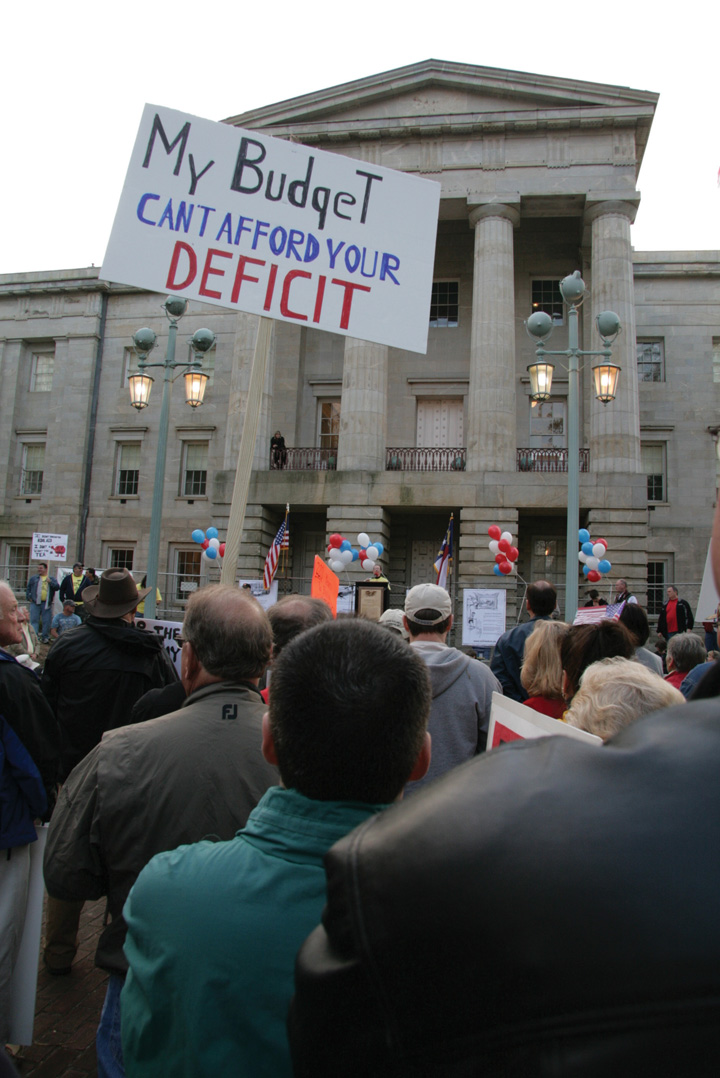
Signs oppose the printing. The majority of Tea Party signs at rallies country result positions without racially charged messages.
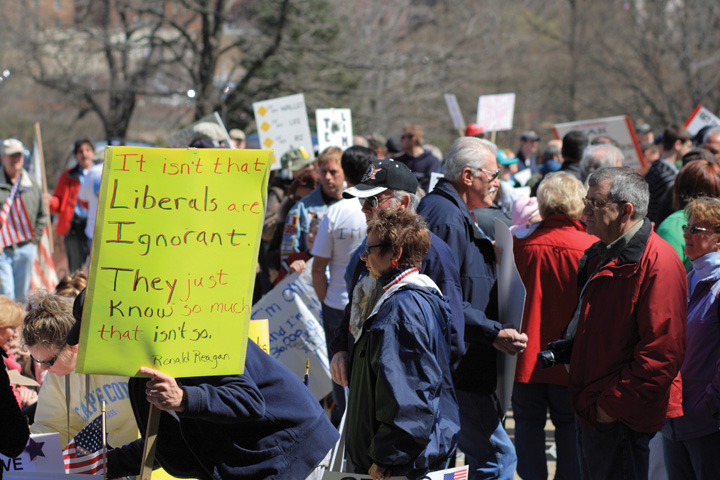
Rally Signs Depict Issue Positions
Studies of mainstream press coverage of the Tea Party also vary markedly depending on the source. A 2010 report by the conservative Media Enquiry Center found that the press first ignored and then disparaged the Tea Party. The study alleged that ABC, CBS, NBC, and CNN framed the Tea Political party as a fringe or extreme racist motion (Noyes, 2011). Conversely, a 2010 survey conducted by the mainstream paper the Washington Post found that 67 percentage of local Tea Political party organizers felt that traditional news media coverage of their groups was off-white, compared to 23 percent who considered it to exist unfair. Local organizers as well believed that news coverage improved over time as reporters interviewed Tea Party activists and supporters and gained firsthand cognition of the grouping and its goals (Gardner, 2011). Both reports were debated widely in the press.
Challenges Facing Small-scale Parties
A minor-party candidate has never been elected president. In the past v decades, minor parties have held few seats in Congress or high-level state offices. Few pocket-size party candidates take won against major-party candidates for governor, state representative, or county commissioner in the past 2 decades. Minor-political party candidates have amend luck in the approximately 65,000 nonpartisan contests for city and town offices and school boards in which no party labels appear on the ballot. Hundreds of these positions have been filled by modest-party representatives (Sifry, 2003).
A majority of the public favors having viable minor-party alternatives in elections (SIfry, 2003). Why, and then, are minor parties unable to be a more than formidable presence in American politics?
Winner-Take-All Elections
Ane major reason for 2-party dominance in the United States is the prominence of the single-member commune plurality system of elections (Duverger, 1972), besides known as winner-take-all elections. Only the highest vote getter in a district in federal and most state legislative elections gains a seat in office. Candidates who have a realistic chance of winning nether such a system are almost always associated with the Democratic and Republican parties, which take a potent following among voters and necessary resources, such as funding and volunteers to work in campaigns.
In contrast, proportional representation (PR) systems, such as those used in most European democracies, allow multiple parties to flourish. PR systems employ larger, multimember districts where five or more members of a legislature may be selected in a unmarried election district. Seats are distributed according to the proportion of the vote won by detail political parties. For case, in a commune comprising x seats, if the Autonomous Party got 50 percent of the vote, it would exist awarded 5 seats; if the Republican Party earned 30 per centum of the vote, it would gain three seats; and if the Green Party earned xx percent of the vote, it would be granted ii seats (Amy, 1993). PR was used for a short time in New York Metropolis quango elections in the 1940s only was abandoned later several communists and other modest-political party candidates threatened the Democratic Political party's stronghold (Rossiter, 1960).
Legal Obstacles
Minor parties are hindered by laws that limit their ability to compete with major parties. Democrats and Republicans in office have created procedures and requirements that make it difficult for minor parties to be listed on ballots in many states. In Montana, Oklahoma, and several other states, a candidate must obtain the signatures of least five percent of registered voters to appear on the ballot. A presidential candidate must collect over one million signatures to exist listed on the ballot in every state. This is an insurmountable bulwark for nigh minor parties that lack established organizations in many states (Rosenstone, Behr, & Lazarus, 2000).
Entrada finance laws work confronting modest parties. The 1974 Federal Ballot Campaign Deed and its amendments provide for public financing of presidential campaigns. Rarely has a modest-party candidate been able to qualify for federal entrada funds every bit the party's candidates must receive v percent or more of the popular vote in the general election. Similar barriers hinder state-level pocket-size-party candidates from receiving public funding for taxpayer-financed campaigns, although some states, such as Connecticut, are debating plans to rectify this state of affairs.
Lack of Resource
The fiscal disadvantage of minor parties impedes their ability to amass resources that are vital to mounting a serious challenge to the two major parties. They lack funds to establish and equip permanent headquarters. They cannot hire staff and experienced consultants to carry polls, get together political intelligence, court the press, generate new media outreach, or manage campaigns (Rosenstone, Behr, & Lazarus, 2000).
Lack of Media Coverage
Minor parties rarely receive significant media coverage except when they field a dynamic or outlandish candidate, such equally Jesse Ventura, or when they are associated with a movement that taps into public concerns, such as the Tea Party. The ascendant horserace frame employed by the media focuses on who is ahead and behind in an election and ordinarily tags modest-party candidates as losers early in the process. Media treat small parties as distractions and their candidates as novelty acts that divert attention from the main two-party attractions.
Minor parties often are unable to air televised campaign ads because they lack funds. Fifty-fifty in the digital era, television advert is an essential part of campaigns because information technology allows candidates to command their own message and reach big numbers of voters. Minor-party candidates have difficulty gaining publicity and gaining recognition among voters when they cannot advertise.
Minor-party candidates routinely are excluded from televised debates in which major-party candidates participate (Rosenstone, Behr, & Lazarus, 2000). By beingness allowed to participate in the 1992 presidential debates, Reform Political party candidate Ross Perot achieved national visibility and symbolic equality with incumbent president George W. Bush and Autonomous candidate Beak Clinton.
Video Prune
Giant Sucking Sound: Ross Perot 1992 Presidential Debate
(click to see video)
Perot received significant press coverage from his debate performance.
Figure 10.8 Ross Perot Participating in the 1992 Presidential Debate
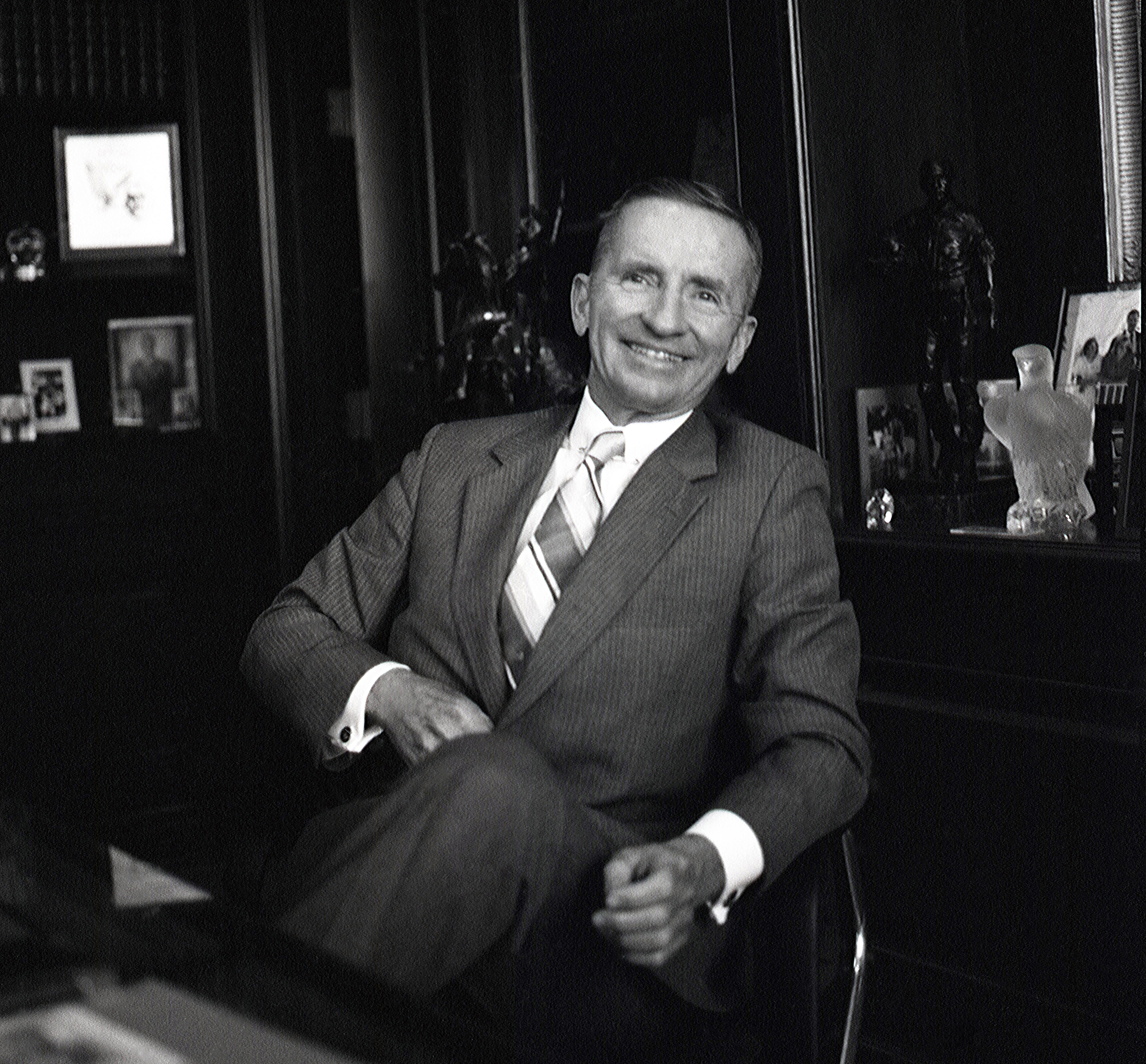
Modest-party candidates rarely have the opportunity to participate in televised presidential debates. An exception was Reform Party candidate Ross Perot, whose campaign was bolstered by his inclusion in the 1992 presidential fence with Republican George Due west. Bush and Democrat Bill Clinton.
These benefits were denied Ralph Nader when he was excluded from the presidential debates in 2000 because the Committee on Presidential Debates ruled that Nader did not have enough voter support to warrant inclusion.
Absorption by Major Parties
When a small-party motion gains momentum, the Republican and Democratic parties move chop-chop to blot the minor party by offering enticements to their members, such as support for policies that are favored by the pocket-size party. Major-political party candidates appeal to minor-party supporters by arguing that votes for pocket-sized-political party candidates are wasted (Rossiter, 1960). Major parties are oft successful in attracting modest-party voters because major parties are permeable and cryptic ideologically (Gillespie, 1993).
Afterwards the Democrats in Congress were instrumental in passing the Voting Rights Deed in 1964, the Republican Party absorbed the southern Dixiecrats, a Democratic Political party faction opposed to the legislation. The 2 major parties tried to concenter Ross Perot's Reform Party supporters afterwards his 1992 presidential bid, with the Republican Party succeeding in alluring the lion's share of votes. The Republican Political party's position against big government appealed to Perot supporters (Rapoport & Stone, 2003). Even though the Tea Party gravitates toward the Republican Party, Republicans accept non universally accustomed it.
Key Takeaways
Modest parties offer an culling to the dominant Republican and Democratic parties, but they have difficulty surviving. They arise to challenge the 2 major parties when people experience that their interests are not being met. In that location are four major types of small parties: enduring, unmarried-issue, candidate-centered, and fusion parties. Pocket-size parties accept difficulty winning high-level office but are able to fill seats at the canton and local level. There are numerous challenges faced by modest parties in American politics, including winner-take-all elections, legal obstacles, lack of resources, and limited media coverage.
Exercises
- When do small-scale parties tend to arise? How can minor parties have an impact on national politics if they cannot normally compete in national elections?
- What minor parties are you familiar with? How are pocket-sized parties generally portrayed in the media?
- What makes it difficult for small parties to win state and local elections?
References
Amy, D. J., Real Choices/New Voices (New York: Columbia University Press, 1993).
Committee for the Study of the American Electorate, "Votes Cast for Presidential Candidates," accessed March 26, 2011, http://world wide web.fairvote.org/turnout/prrevote2000.htm.
Duverger, M., Party Politics and Pressure level Groups (New York: Thomas Y. Crowell, 1972).
Gardner, A., "Tea Political party Groups Say Media Have Been Off-white, Survey Finds," Washington Postal service, October 26, 2010, accessed March 26, 2011, http://www.washingtonpost.com/wp-dyn/content/article/2010/ten/26/AR2010102602796.html.
Gillespie, J. D., Politics at the Periphery (Columbia: Academy of South Carolina Printing, 1993).
Green, J. C. and William Binning, "Surviving Perot: The Origins and Future of the Reform Political party," in Multiparty Politics in America, ed. Paul Due south. Herrnson and John C. Green (Lanham, MD: Rowman & Littlefield, 1997), 87–102.
Jan, G., "The Dark-green Political party: Global Politics at the Grassroots," in Multiparty Politics in America, ed. Paul S. Herrnson and John C. Green (Lanham, Medico: Rowman & Littlefield, 1997), 153–57.
Mazmanian, D. A., Third Parties in Presidential Elections (Washington, DC: Brookings Institution, 1974).
Noyes, R., "Tv's Tea Party Travesty," Media Enquiry Middle, April 15, 2010, accessed March 26, 2011, http://www.mrc.org/specialreports/uploads/teapartytravesty.pdf.
Owen, D. and Jack Dennis, "Antipartyism in the USA and Support for Ross Perot," European Journal of Political Inquiry 29 (1996): 383–400.
Rapoport, R. B. and Walter J. Stone, "Ross Perot Is Alive and Well and Living in the Republican Political party: Major Political party Co-optation of the Perot Movement and the Reform Party," in The State of the Parties, 2nd ed., ed. John C. Dark-green and Rick Farmer (Lanham, Doctor: Rowman & Littlefield, 2003), 337–53.
Rogers, T., "Both Pull a fast one on News and CNN Made Mistakes in Tea Party Protest Coverage," About.com Journalism, accessed March 26, 2011, http://journalism.about.com/od/ethicsprofessionalism/a/teaparty.htm.
Rosenstone, South. J., Roy L. Behr, and Edward H. Lazarus, Third Parties in America, 2nd ed. (Princeton, NJ: Princeton University Press, 2000).
Rossiter, C., Parties and Politics in America (Ithaca, NY: Cornell University Press, 1960).
Vicious, T., "The Libertarian Party: A Pragmatic Approach to Party Building," in Multiparty Politics in America, ed. Paul S. Herrnson and John C. Greenish (Lanham, Md: Rowman & Littlefield, 1997), 141–45.
Sifry, M. L., Spoiling for a Fight (New York: Routledge, 2003).
Stelter, B., "In News Coverage, Tea Party and Its 'New Personalities' Concord the Spotlight," New York Times, Nov 3, 2010.

What Are Economic Protest Parties,
Source: https://open.lib.umn.edu/americangovernment/chapter/10-6-minor-parties/
Posted by: bowlestheaverpre.blogspot.com
0 Response to "What Are Economic Protest Parties"
Post a Comment